
The latest USDA Objective Measurement Report confirms a significant reduction in California walnut production, with a lower nut set per tree and considerable differences among varieties and growing regions.
USDA/NASS has released its highly anticipated 2026 California Walnut Objective Measurement Report, forecasting California walnut production at 680,000 tons, compared with 809,000 tons in 2025.
The new estimate represents a 16% decrease from last year’s crop. Preliminary bearing acreage for 2026 is estimated at 371,000 acres.
Lower nut set per tree
One of the most significant figures in the report is the reduction in the average number of walnuts per tree.
The USDA survey reports an average of 796 nuts per tree in 2026, compared with 972 nuts in 2025, representing a decrease of approximately 18%.
The 2026 objective measurement survey covered 749 blocks and 1,498 trees across California’s main walnut-growing areas.
Chandler nut set falls by almost 20%
Chandler, the leading California walnut variety and particularly important for international markets, also shows a significant reduction.
USDA reports an average of 826 nuts per tree for Chandler, compared with 1,025 nuts in 2025, representing a decrease of approximately 19%.
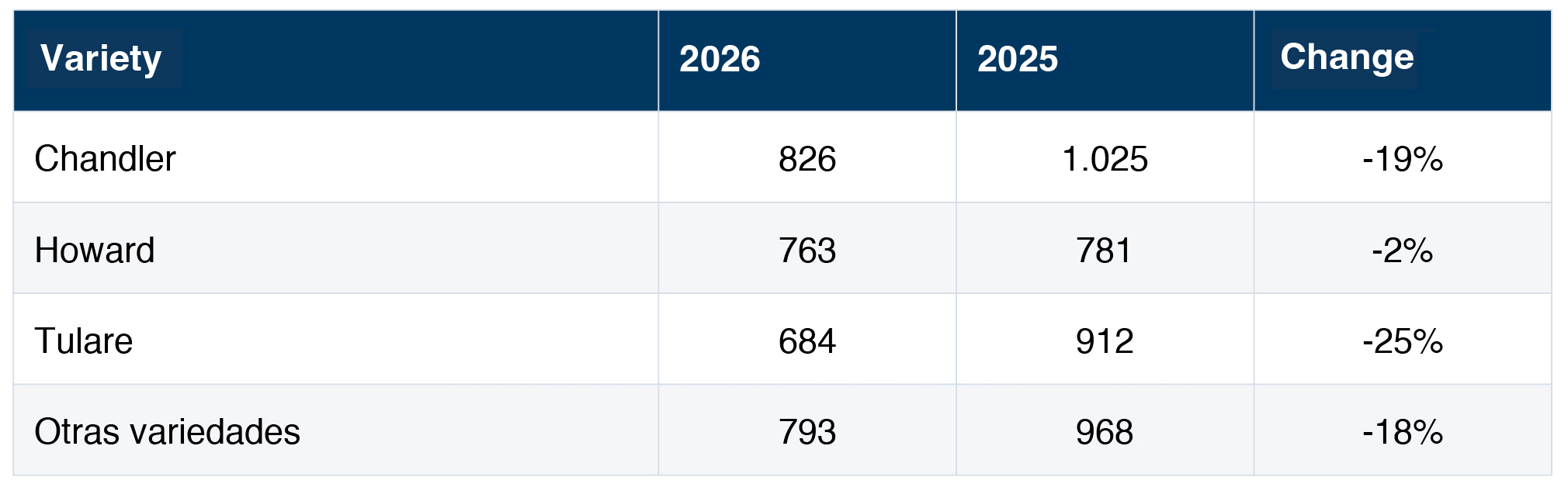
Significant differences between growing regions
Crop conditions are not uniform across California’s walnut-producing regions. Several important production areas show substantial reductions in nut set compared with 2025, while other regions are performing more favourably.
This geographical variability will be an important factor to monitor as the harvest progresses, particularly when assessing the final availability of specific varieties, sizes and quality levels.
An estimate that still needs to be confirmed by the harvest
The current forecast of 680,000 tons is approximately 129,000 tons below the final 2025 production.
However, it is important to remember that the Objective Measurement Report provides a crop forecast rather than the final volume received. In 2025, USDA initially forecast a crop of 710,000 tons, while final production eventually reached approximately 809,000 tons.
Therefore, although the 2026 survey provides objective evidence of a lower nut set per tree, actual crop receipts will need to be closely monitored before the final size of the California crop can be determined.
What can we expect from the market?
The USDA report points to a crop potentially considerably smaller than the exceptionally large 2025 production.
Market attention will now move beyond overall production figures to other key factors such as size, colour, kernel yield and availability by variety.
These factors will ultimately determine California’s actual commercial supply and will play an important role in the development of the international walnut market during the 2026/27 season.
SECOEX INTERNATIONAL FOOD BROKERS will continue to closely monitor the harvest and market developments to keep our customers and partners informed.
Source: USDA – National Agricultural Statistics Service (NASS), California Walnut Objective Measurement Report, October 1, 2026.
